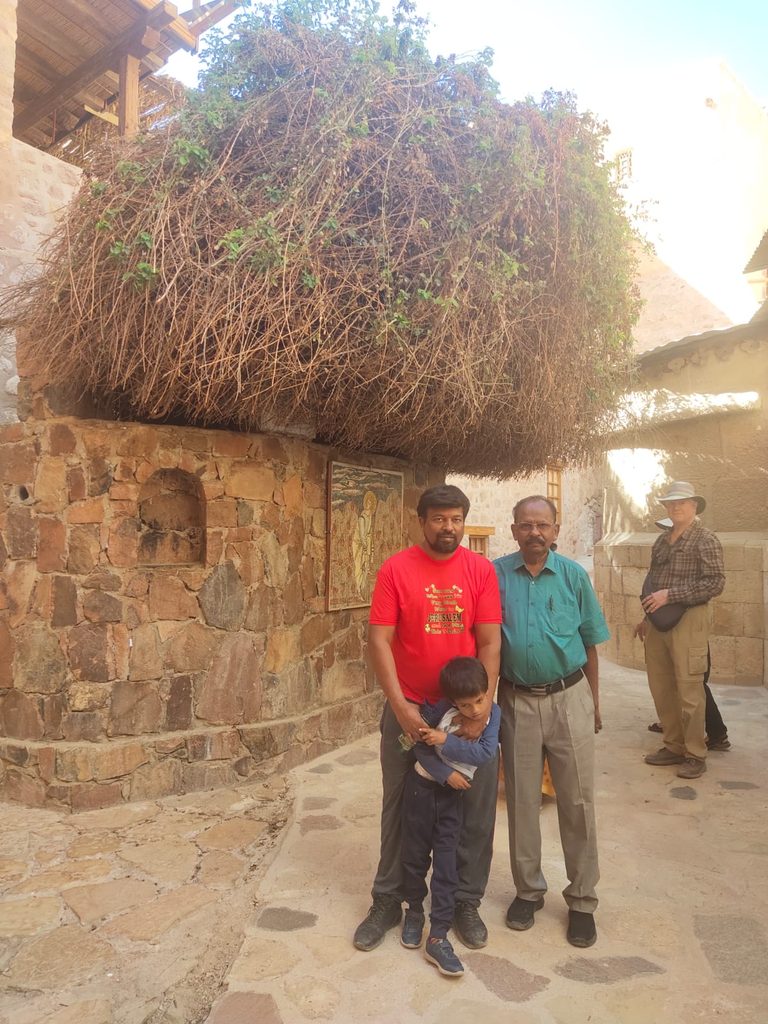
Growing up reading Exodus 3, the account of the burning bush felt like an abstract myth set in a nameless desert. But there is a real, geographical coordinate on the map: Saint Catherine’s Monastery, located at the base of Mount Sinai (Jabal Musa) in Egypt’s Sinai Peninsula.
Standing in that dry, high-altitude valley makes centuries of tradition immediately tangible.
The Road into the Desert
Getting to the site is an adventure in itself. Leaving behind the turquoise waters of the Red Sea—whether starting from Dahab or Sharm El Sheikh—the highway cuts deep into a landscape of stark, red granite crags. The deeper you travel into southern Sinai, the quieter it becomes. Cell service fades, tourist crowds thin out, and the horizon fills with scorched rock.
By the time the massive 6th-century stone walls of Saint Catherine’s Monastery appear around a bend in the valley, the isolation feels total. Built by Byzantine Emperor Justinian to protect the monks and the sacred sites, it is the oldest continuously inhabited Christian monastery in the world.
Encountering the Bush
Inside the fortress walls, past ancient archways and centuries-old olive trees, lies an open-air stone courtyard. Spilling over a raised terrace wall is the legendary bush itself: a sprawling, bright green bramble botanically classified as Rubus sanctus.
A few things stand out immediately when you see it up close:
- The Defiance of Green: In a landscape dominated entirely by ochre, dust, and scorched rock, the bush is strikingly vibrant. Its lush leaves feel almost out of place against the sheer granite cliffs towering directly behind it.
- A Resilient Relic: The monks have tended this specific bush for well over a millennium. Local tradition notes that numerous attempts have been made to cultivate cuttings of this plant in other soils and gardens across the world, but none have ever successfully rooted outside this specific microclimate.
- The Chapel of the Bush: Directly adjacent sits the Chapel of the Burning Bush. In keeping with the biblical command—“Take off your sandals, for the place where you are standing is holy ground”—every visitor must remove their shoes before walking inside. The altar inside does not sit on typical stone masonry; it is built directly over where the roots of the original bush are believed to lie.
The Atmosphere of the Valley
What surprises most travelers is not just the physical bush, but the sensory weight of the place.
Once the morning tour groups disperse and the diesel engines of local minibuses shut off, the valley sinks into absolute stillness. The dry desert wind brushing against granite is the only sound. In that silence, it is easy to see why ancient shepherds, prophets, and seekers retreated into the Sinai wilderness. The desert strips away noise until all that remains is clarity and scale.
Whether you approach Saint Catherine’s from a perspective of personal faith, archaeological curiosity, or love for rugged travel, standing before the bush bridges the gap between text and reality. It takes an ancient story about a wandering shepherd and places it firmly in the dust, sun, and stone of the real world.
Practical Travel Notes for Your Visit
- Opening Hours: Saint Catherine’s has very limited visiting hours—typically open to visitors from 9:00 AM to 11:30 AM, and closed completely on Fridays, Sundays, and major Eastern Orthodox feast days.
- Dress Code: Modest attire is strictly enforced. Shoulders and knees must be fully covered to enter the monastery grounds.
- Combining with Mount Sinai: Many travelers arrive at 1:00 AM, hike the 2,285-meter summit of Mount Sinai with a Bedouin guide to watch the sunrise, and then descend in time to explore the monastery and burning bush when the gates open in the morning.
Leave a Reply